Useful Educational Platforms and Their Role in Developing the Educational Process


E-learning today is witnessing remarkable growth due to the widespread adoption of digital technologies and the emergence of useful educational platforms in education that rely on modern teaching approaches.
Learning environments are no longer limited to traditional classrooms. Instead, they increasingly depend on interactive digital platforms that enable students and teachers to communicate and learn anytime and anywhere with efficiency and ease.
These platforms are considered among the most important tools of digital transformation in education, as they provide rich learning environments filled with diverse resources and interactive activities. They promote active learning and open the door to self-directed and independent learning experiences.
The Importance of Digital Educational Platforms
Digital educational platforms contribute to improving the educational process in several ways. They offer diverse content such as videos, lessons, and interactive assessments, while also facilitating instant communication between teachers and students.
In addition, these platforms support immediate feedback and performance analysis through data, helping teachers accurately identify students’ strengths and areas for improvement. One of their most significant advantages is that they make learning more engaging and interactive, increase student motivation, and encourage active participation within the digital learning environment.
Examples of Useful Educational Platforms
- Google Classroom — Organizes lessons and assignments and allows easy tracking of student progress.
- Microsoft Teams for Education — Supports collaborative learning, shared files, and virtual classes.
- Edmodo — A secure academic social learning network for educational interaction.
- Kahoot & Quizizz — Interactive educational games based on challenge and competition.
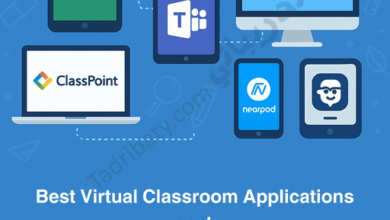
- Nearpod & ClassPoint — Transform presentations into interactive lessons with live questions and polls.
- Coursera & EdX — Courses from international universities that support continuous self-learning.
Choosing the most suitable platform depends on learning objectives, learners’ age groups, and the available technical infrastructure.
Conclusion
Educational platforms are no longer an optional addition but a necessity for developing digital skills among students and teachers. They help build a generation capable of self-learning, critical thinking, and engaging with knowledge in innovative ways.
With the continuous advancement of educational technologies and the integration of artificial intelligence and augmented reality, learning experiences will become more personalized and interactive than ever before—making the digital school a hub of creativity without limits of time or place.
Read also:
• Interactive Tools in Education and Their Role in Promoting Active Learning
• Best Virtual Classroom Applications and How to Use Them in Teaching
• Effective Strategies for Designing Learner-Centered Worksheets (With Ready-to-Use Templates)
• Differentiated Instruction – Practical Steps and Classroom Examples