American vs British Schools in Qatar: Which Is Right for Your Child?

Choosing a school in Qatar often leads parents to one important question:
Should I choose an American or a British school for my child?
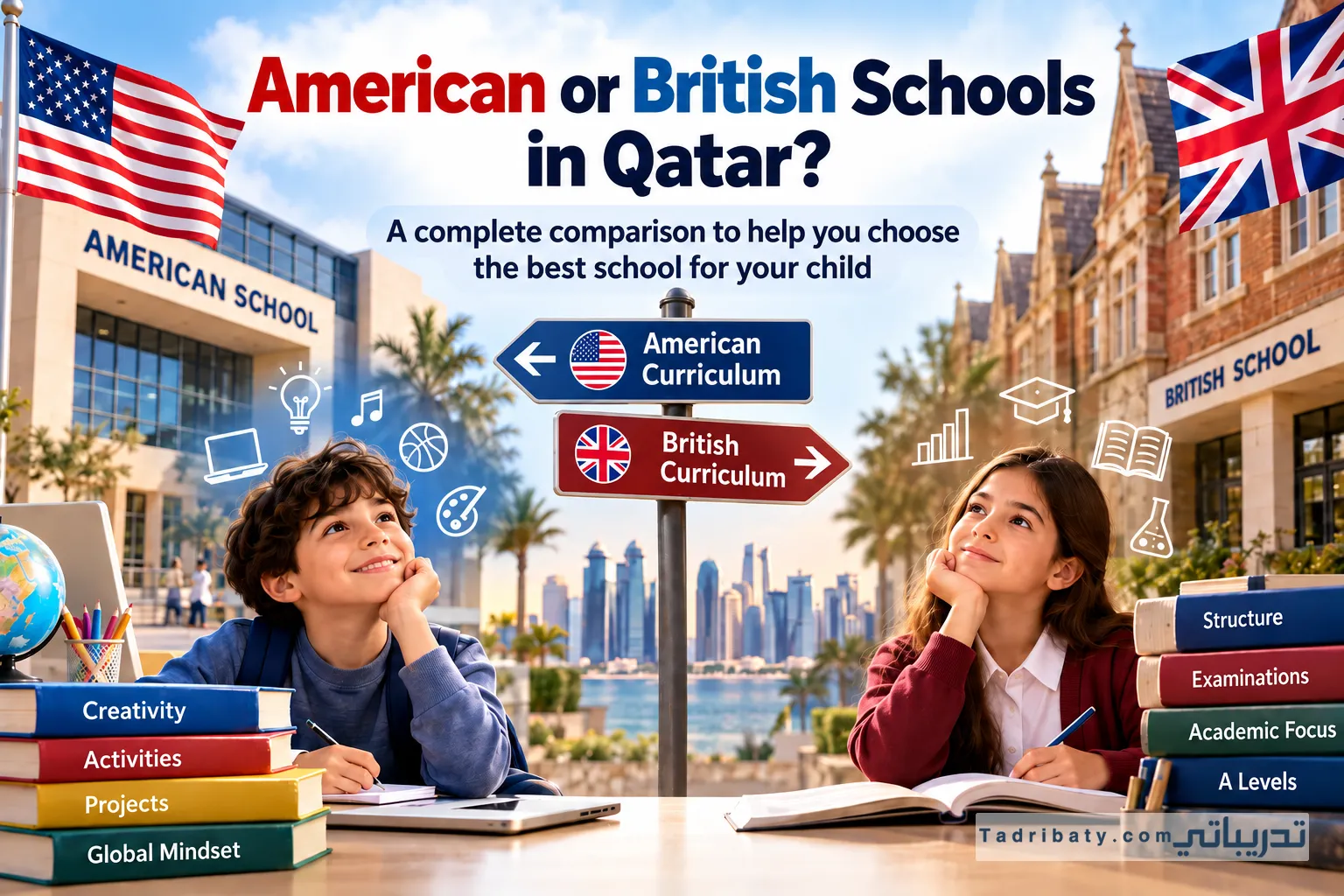
At first, the choice may seem to be simply about curriculum. In reality, American and British schools can differ in their teaching approaches, assessment methods, grade structures, secondary-school pathways, fees, and overall learning environments.
More importantly, there is no single curriculum that is automatically “better” for every child. A school that works extremely well for one student may not be the right fit for another.
In this guide, Tadribaty compares American and British schools in Qatar from a practical parent’s perspective, helping you understand the main differences before comparing individual schools.
American vs British Schools in Qatar: Quick Comparison
| Comparison | American Schools | British Schools |
|---|---|---|
| Grade structure | Kindergarten / Grade system | Reception / Year / Key Stages |
| Teaching approach | Often combines academic learning with projects and activities | Usually follows a more clearly structured sequence of academic stages |
| Assessment | Often combines tests, classwork, projects and continuous assessment | School-based assessment throughout the years, with greater importance placed on external qualifications in later stages |
| Secondary pathway | High School Diploma; AP or other programs may be available depending on the school | IGCSE followed by AS/A Level or other British pathways depending on the school |
| Subject flexibility | May offer greater flexibility in subject choices, particularly in high school | Students generally specialize more as they progress through secondary education |
| May Be More Suitable For | May be more suitable for students who benefit from varied assessment methods, projects and activities, and relative flexibility in their academic pathway | May be more suitable for students who prefer a more structured and clearly defined academic pathway, progressing towards IGCSE and then AS or A Level, depending on the school |
Important Note: This does not mean that the American system is suitable for one specific type of student and the British system for another. Schools themselves vary considerably in their teaching methods, workload, assessment practices, and academic support. Therefore, parents should consider the individual school, their child’s personality and needs, as well as the curriculum.
1. How Does the American School System Work?
American schools generally use the Grade system, with students progressing through school until Grade 12.
A common feature of American education is the use of several forms of assessment. Depending on the school, a student’s final grade may include:
- Tests and quizzes
- Homework
- Classroom participation
- Projects
- Assignments
- Continuous assessment throughout the academic year
This can allow students to demonstrate their abilities in different ways rather than relying entirely on major examinations.
However, not all American schools follow exactly the same program.
Curriculum standards, accreditation, graduation requirements and advanced programs can vary considerably between schools.
Therefore, when considering an American school in Qatar, don’t ask only:
“Does the school follow an American curriculum?”
Also ask about its accreditation, high-school program, graduation requirements and available subjects.
2. How Does the British School System Work?
British schools use a different structure, including terms such as Reception, Year Groups and Key Stages.
As students progress into secondary education, they may work towards qualifications such as:
IGCSE → AS Level → A Level
depending on the program offered by the individual school.
This creates a relatively clear academic pathway, particularly during secondary education, when students begin narrowing their subject choices according to their interests and future university plans.
For families in Qatar, it is also important to understand the requirements associated with British secondary qualifications, particularly if the student will later need certificate equivalency in Qatar.
Parents of older students should therefore investigate these requirements well before the final years of school.
3. What Is the Difference in Teaching and Assessment?
One common misconception is that the American curriculum is “easy” while the British curriculum is “hard.”
The reality is much more complicated.
A student may feel more comfortable in an American program because they enjoy projects, participation and assessment spread throughout the academic year.
Another student may prefer the British system because they perform well with structured content, clearly defined academic targets and formal examinations.
The better question is not:
Which curriculum is easier?
Instead, ask:
Which learning and assessment style suits my child?
| If your child tends to enjoy… | Consider exploring… |
|---|---|
| Projects and classroom participation | American schools that emphasis these approaches |
| Clearly structured academic stages | British schools |
| Different ways to demonstrate achievement | Schools offering varied assessment methods |
| Formal and structured examinations | British pathways may be worth exploring |
| Focusing on selected subjects in later secondary school | Advanced British programs |
| Broader subject and activity choices | American programs offering this flexibility |
This table is only a starting point, not a rule for choosing your child’s school.
4. Which Curriculum Is Better for Primary School?
This is an important question for many parents.
During the early years, children are not simply collecting grades. They are discovering how they learn, what interests them and where their strengths may lie.
Their interests in science, technology, sport, art, reading, communication or other areas may become clearer during these years.
For this reason, some parents choose an American school during kindergarten and primary education, particularly when the school offers a learning environment with plenty of projects, activities and opportunities for exploration.
The aim may be to give the child more space to discover their interests, develop confidence and explore different talents.
Later, as the child becomes more academically mature, some families consider moving to a British school if they believe their child would benefit from a more structured academic pathway and increasing subject specialization.
Is the “American First, British Later” Approach Right for Everyone?
No.
This is an option considered by some families, not an educational rule.
A child who is happy and progressing well in an American school may have no reason to change curriculum. Another child may thrive in a British school from the beginning.
Moving between two education systems should therefore not happen simply because a child reaches a particular age.
Parents should first consider the differences in curriculum content, grade equivalency and the admission requirements of the new school.
5. Can My Child Transfer from an American to a British School in Qatar?
It is possible to transfer between different education systems in Qatar, but the transition should be planned carefully.
Before making the decision, ask the new school about:
- The year group in which your child would be placed
- Differences between previously studied and required subjects
- Expected English-language level
- Admission tests or assessments
- Subjects in which additional support may be required
- The impact of the transfer on the student’s future secondary-school pathway
Do not assume that the same grade number means the same educational level across different curricula.
Qatar has official requirements and equivalency guidance for placing students transferring between different educational systems. Parents should therefore confirm the current requirements with the receiving school and the relevant Ministry of Education and Higher Education guidance before completing a transfer.
6. British Schools Have a Strong Presence in Qatar
Parents exploring private education in Qatar will quickly notice the strong presence of British-curriculum schools.
Official Ministry of Education and Higher Education information published over the years also reflects the substantial size of the British-curriculum sector.
For example, in one Ministry announcement concerning new private schools and kindergartens expected to open for an academic year, nine followed the British curriculum compared with two following the American curriculum.
Other Ministry data on available private-school seats has also shown a larger number of available places within the British curriculum than the American curriculum at the time the figures were published.
These historical figures should not be treated as a current count of British and American schools. However, they illustrate the significant presence of British education within Qatar’s private-school sector.
For parents, a larger pool of schools can have a practical advantage: more options across locations, fee ranges and school environments.
However, the number of schools is not a measure of educational quality, and greater availability does not mean that the British curriculum is automatically better than the American curriculum.
7. What About School Fees?
School fees are naturally one of the biggest considerations for families in Qatar.
However, comparing only the headline annual tuition fee can be misleading.
Before registering, check whether there are additional charges for:
- Application or registration
- Re-enrollment
- Books and learning resources
- School uniforms
- Transportation
- Activities and trips
- External examinations
- Other compulsory charges
A school with lower advertised tuition may ultimately cost more once additional compulsory expenses are included.
For a fair comparison, calculate the estimated total annual cost per child, not tuition alone.
8. Don’t Choose Based Only on Curriculum and Fees
Once you have narrowed your search to American or British schools within your budget, the most important comparison begins:
the individual schools themselves.
What Should Parents Compare?
| Factor | What should you ask? |
|---|---|
| Academic progress | How does the school monitor student progress? |
| Accreditation | What accreditation does the school hold? |
| Class size | How many students are usually in each class? |
| Teachers | How experienced and stable is the teaching staff? |
| Safety | What supervision and safeguarding procedures are in place? |
| Bullying | Does the school have a clear anti-bullying policy? |
| Parent communication | How does the school communicate concerns and progress? |
| Activities | Are there activities that match your child’s interests? |
| Arabic | How is Arabic supported within the school program? |
| Learning support | What happens when a student falls behind? |
| Location | How much time will your child spend traveling each day? |
| Fees | What is the complete annual cost? |
Private schools in Qatar also operate within national requirements concerning subjects such as Arabic, Islamic Studies, Qatar History and citizenship-related learning, depending on the applicable student categories and regulations.
Parents can ask each school how these subjects are incorporated into its program.
9. Which Curriculum Might Suit Your Child?
If your child prefers projects, activities, varied assessment methods, and flexibility, the American system may suit them better. If they prefer structured learning and a clearly defined academic pathway, the British system may be a better fit.
In both cases, the individual school and your child’s personality matter more than the curriculum name alone.
Explore American schools further if your child:
- Enjoys projects and practical learning
- Likes participating and discussing ideas
- Benefits from different forms of assessment
- Has several interests they would like to explore
Explore British schools further if your child:
- Prefers clearly defined academic goals
- Performs well in structured examinations
- Is comfortable specializing in fewer subjects as they progress through secondary school
- Prefers a clearly structured academic pathway
Remember: these are indicators to help your search, not a test that determines which curriculum your child should follow.
10. Don’t Rely on School Reputation Alone
One parent may tell you that a particular school is excellent, while another describes a completely different experience.
Both may be telling the truth.
A child who needs close individual support has different needs from an independent learner. A highly social child may experience a school differently from a quieter student. What one family considers strong discipline may feel overly restrictive to another.
Use other parents’ experiences to discover which questions you should ask, rather than using individual reviews as the final verdict on a school.
Search American and British Schools in Qatar with Tadribaty
Once you understand the differences between the two systems, you don’t need to keep reading dozens of articles.
The next step is to move from understanding the curriculum to comparing actual schools.
Tadribaty provides dedicated school search tools to help parents explore available options using school information in one place.
American Schools in Qatar
Explore American schools and compare the available information:
[Search American Schools in Qatar]
British Schools in Qatar
If the British system appears closer to your child’s needs:
[Search British Schools in Qatar]
Tip: Shortlist around three to five schools, then check their official websites, contact their admissions teams and, where possible, visit the schools before making your final decision.
Before You Choose: 8 Questions to Ask the School
Take these questions with you when contacting or visiting a school:
- What is the total annual cost after all compulsory fees?
- How many students are typically in each class?
- How is my child assessed throughout the year?
- What happens if my child falls behind in a subject?
- What is the school’s policy on bullying and behavioral issues?
- What sports, arts, technology, and extracurricular activities does the school offer, and are they included in the fees?
- What accreditation does the school hold, and what secondary pathway does it offer?
- If we decide to move to another curriculum later, what should we know now?
Clear answers to these questions will usually tell you far more than the curriculum label alone.
Frequently Asked Questions
Is the British curriculum harder than the American curriculum?
There is no single answer that applies to every school or student. The systems differ in their structures and assessment approaches. Some students perform better with continuous and varied assessment, while others prefer structured academic targets and formal examinations.
Is the American curriculum better for primary school?
It can suit children who benefit from projects, activities and varied forms of assessment, but the quality of the child’s experience depends heavily on the individual school rather than the curriculum label alone.
Can my child start in an American school and later move to a British school?
Yes, transferring between different educational systems in Qatar can be possible, subject to applicable requirements. Parents should check grade equivalency, admission requirements and possible academic gaps with the receiving school before transferring.
Is changing curriculum after primary school a good idea?
It may be appropriate for some children, particularly when their academic needs and learning style have become clearer. However, changing curriculum is not necessary simply because a child has finished primary school. There should be a clear reason for making the move.
Are there more British or American schools in Qatar?
The British curriculum has a substantial presence in Qatar’s private education sector, and historical official data has reflected a large British-curriculum sector compared with the American sector. For a current comparison, parents should use updated school listings rather than relying on historical figures alone.
Is a more expensive school automatically better?
No. Higher fees may reflect facilities, location, activities or additional services, but tuition fees alone cannot determine teaching quality or whether a school is suitable for your child.
Should I think about university when choosing a school for a young child?
It is useful to understand where each curriculum can lead, but university should not be the only consideration for a young child. At this stage, teaching quality, safety, well being, confidence and opportunities to discover the child’s abilities are also important.
What should I look for when visiting a school?
Look beyond the marketing materials. Observe how teachers interact with students, the atmosphere and discipline of the school, class sizes, how openly staff answer your questions and whether the overall environment appears suitable for your child’s personality.
American or British: What Should You Choose?
There is no single answer for every family.
An American program may suit a child who enjoys exploration, projects and varied learning experiences, while another child may feel more comfortable with the structured stages and academic pathway of a British program.
Some families may choose an American school during the primary years and reconsider their options as the child approaches secondary education. Others may prefer to remain within the same educational system from the early years through graduation.
So instead of starting with:
“Which is better: American or British?”
start with:
“What learning environment does my child need now, and which options do I want to keep open for the future?”
Once you have answered that question, use Tadribaty’s school search tools to create a shortlist and compare schools by fees, location, grade levels, accreditation and educational environment before making your final decision.
📚 Read also
🏫 Related Articles & Guides
🔎 Find a School in Qatar
- American Schools in Qatar
- British Schools in Qatar
- Schools Portal in Qatar
- Educational Centers Portal in Qatar