Ready-to-Use Educational Competitions for Schools (Ideas and Diverse Activities)

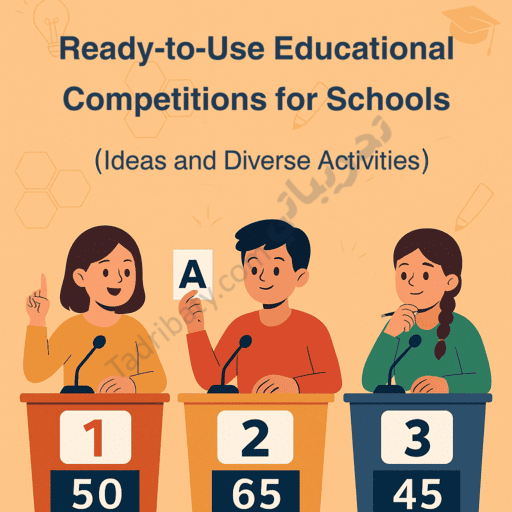
Ready-to-Use Educational Competitions for Schools are among the most effective activities for promoting positive competition among students and increasing their motivation to learn. They combine learning, fun, critical thinking, and collaboration at the same time, making them a powerful tool for enriching the educational process and activating active learning. Since teachers and school administrations are always looking for easy and quick-to-apply ideas, this article presents a collection of competitions that can be implemented in the classroom, during morning assembly, or in activity periods.
First: Ready Classroom Competitions (Quick and Easy to Implement)
“Fastest Answer” Competition
- The teacher asks 10 short questions.
- Students raise cards with their answers.
- One point is awarded for each correct and fast answer.
- Materials: A–B–C–D cards
- Goal: Stimulating quick thinking.
“Who Remembers More?” Competition
- Students are given one minute to read a list of words or concepts.
- They then write down as many items as they can remember.
- Goal: Enhancing memory and comprehension.
“Complete the Definition” Competition
- The teacher writes a definition missing the key term.
- Students guess the correct term.
- Suitable for: Science – Mathematics – Computing – Arabic Language.
Second: Fun Group School Competitions
“Knowledge Corridor” Competition
- The school prepares a corridor with informational cards.
- Students walk through it and collect answers to the posted questions.
- Goal: Interactive, movement-based learning.
“Learning Stations” Competition
- The school is divided into stations (Science – Math – Language – Sports).
- Teams rotate between stations and complete a short task at each one.
- Goal: Strengthening teamwork skills.
“Reading Challenge”
- A book or short story is selected.
- Students answer questions after reading.
- A “Best Summary” section can be added.
- Goal: Supporting reading and comprehension skills.
Third: Subject-Based Educational Competitions
“Guess the Number” – Mathematics
- The teacher provides clues about a hidden number.
- Students try to guess it.
- Goal: Developing reasoning and inference skills.
“The Missing Word” – Arabic Language
- The teacher writes an incomplete sentence.
- Students choose the correct word from multiple options.
- Goal: Improving vocabulary and grammar.
“The Missing Code” – Computing
- The teacher presents incomplete code and asks students to complete it.
- Goal: Enhancing basic programming skills.
Fourth: Life Skills and Creative Competitions
“Best Innovative Idea” Competition
- Students present a simple project or improvement idea.
- Evaluation is based on innovation and practicality.
- Suitable for: STEM – Computing – Life Skills.
“Dialogue Skills” Competition
- Two teams debate a specific topic.
- Students are assessed on presentation and persuasion skills.
- Goal: Enhancing communication skills.
“Creative Arts” Competition
- Competitions in drawing, calligraphy, photography, or handicrafts.
- Goal: Highlighting student talents and building self-confidence.
Fifth: Tips for Organizing Successful Educational Competitions
- Choose competitions that are easy to implement with clear instructions.
- Set clear evaluation criteria to ensure fairness.
- Keep rewards simple but motivating (certificates, medals, stickers).
- Encourage all students, not only high achievers.
- Link the competition to lesson objectives or the school’s overall goals.
Organizing ready-to-use educational competitions for schools does not require extensive resources; it requires suitable ideas and genuine student motivation. These varied activities increase enjoyment in the classroom, boost participation, and effectively support active learning.
Start by trying one of the competitions above, and you will notice a significant improvement in student engagement and motivation.
Read also:
• Ready-to-Use Classroom Activities for Teachers (Immediately Applicable in the Classroom)
• Educational Games to Develop Thinking and Problem-Solving Skills (Ready to Use)
• Life Skills Every Student Should Learn (A Practical Guide for Schools and Families)
• Effective Strategies for Designing Learner-Centered Worksheets (With Ready-to-Use Templates)