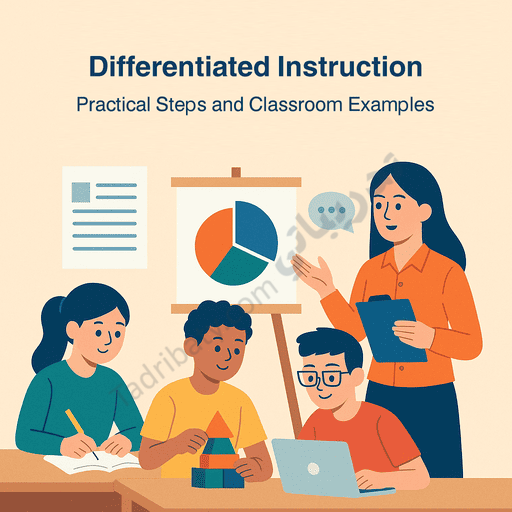
Differentiated instruction is considered one of the most important modern teaching strategies aimed at meeting the needs of all learners in the classroom, regardless of their levels, abilities, interests, or learning styles. Not all students learn in the same way or at the same pace, and this is where differentiation plays a vital role in making a real difference in improving student learning and increasing engagement.
In this article, we present the concept of differentiated instruction, how to apply it, practical steps, and ready-to-use classroom examples.
First: What Is Differentiated Instruction?
Differentiated instruction is a teaching approach based on varying teaching methods, activities, and assignments so that each student receives what suits their level and abilities.
Differentiation can be applied through:
- Process (how students learn)
- Product (how students demonstrate learning)
- Content (what students learn)
- Classroom environment
- Instructional resources and media
The ultimate goal is to ensure the success of every student according to their individual needs.
Second: Why Use Differentiated Instruction?
✔ Helps address individual differences
✔ Builds students’ self-confidence
✔ Increases engagement and motivation
✔ Improves learning outcomes
✔ Encourages self-directed learning and responsibility
✔ Creates a fair and inclusive learning environment
Third: Practical Steps to Implement Differentiated Instruction in the Classroom
- Identify Each Student’s Level
Begin by collecting accurate information about:
- Student performance
- Learning pace
- Strengths and weaknesses
- Learning styles (visual, auditory, kinesthetic)
- Interests
This can be done through:
- Pre-assessments
- Direct observation
- Analysis of previous results
- Interest surveys
- Define Core Skills Required for All Students
Some content must be learned by all students, regardless of their level.
Example:
In a lesson on nominal sentences, all students should understand:
- The subject
- The predicate
However, the way they reach this understanding may differ.
- Vary Instructional Methods
Instead of using a single method, present content in multiple ways, such as:
- Short videos
- Reading texts
- Group activities
- Hands-on experiments
- Simplified worksheets
- Visual presentations
- Group Students According to Their Needs
Groups do not have to be fixed.
Types of groups may include:
- Support group (needs extra explanation)
- Extension group (advanced students)
- Cooperative learning group
- Individual practice group
- Differentiate Activities During the Lesson
This is where the true power of differentiated instruction appears.
Examples:
- Three levels of worksheets (easy – medium – advanced)
- Three different tasks for the same objective
- Short enrichment activities for fast learners
- Support activities for students who need more time
- Differentiate the Product (Learning Outcomes)
Allow students to choose how they demonstrate their learning.
Examples of different products:
- Written summary
- Audio recording
- Mind map
- Slide presentation
- Short video
- Illustrative drawing
- Provide Continuous Feedback
Differentiation without feedback will not be effective.
Guidance and feedback help students improve their performance step by step.
Fourth: Ready-to-Use Classroom Examples of Differentiated Instruction
📌 Example 1: Science Lesson – “Parts of a Plant”
Common objective:
Identify plant parts and their functions.
Differentiated content:
- One group watches an animated video.
- One group completes a cut-and-paste plant diagram.
- One group reads a short text and extracts the parts.
Different products:
- Drawing
- Paper poster
- Audio explanation
📌 Example 2: Arabic Language Lesson – “Writing a Short Paragraph”
Common objective:
Write a coherent paragraph.
Differentiated activities:
- Level 1: Arrange scrambled sentences.
- Level 2: Write a paragraph using guiding questions.
- Level 3: Write a free paragraph including examples and details.
📌 Example 3: Mathematics Lesson – “Addition Using Patterns”
Differentiated activities:
- Simplified worksheet with direct addition
- Worksheet with larger numbers
- Word problems requiring higher-order thinking
📌 Example 4: Computing Lesson – “Algorithms”
Differentiated tasks:
- One group draws algorithm steps.
- One group arranges pre-written steps correctly.
- One group writes an algorithm to solve a simple problem (advanced level).
Fifth: Digital Tools That Support Differentiated Instruction
- Nearpod — Multi-level interactive activities
- ClassPoint — Live questions and performance reports
- Google Classroom — Assign different tasks to each student
- Kahoot / Quizizz — Quick assessments based on student level
- Canva for Education — Multiple product options for students
Implementing differentiated instruction does not mean increasing the teacher’s workload. Rather, it is a smart way to manage the classroom and meet students’ needs more fairly and effectively. When students feel that their differences are understood and respected, motivation increases and learning becomes deeper and more sustainable.
Differentiation is the key to making education more human-centered, engaging, and effective.
Read also:
• Addressing Individual Differences in the Classroom – Practical Strategies for Teachers
• Effective Strategies for Designing Learner-Centered Worksheets (With Ready-to-Use Templates)
• Ready-to-Use Classroom Activities for Teachers (Immediately Applicable in the Classroom)
• Using Feedback to Improve Student Learning (Examples and Ready-to-Use Models)