Educational Games to Develop Thinking and Problem-Solving Skills (Ready to Use)

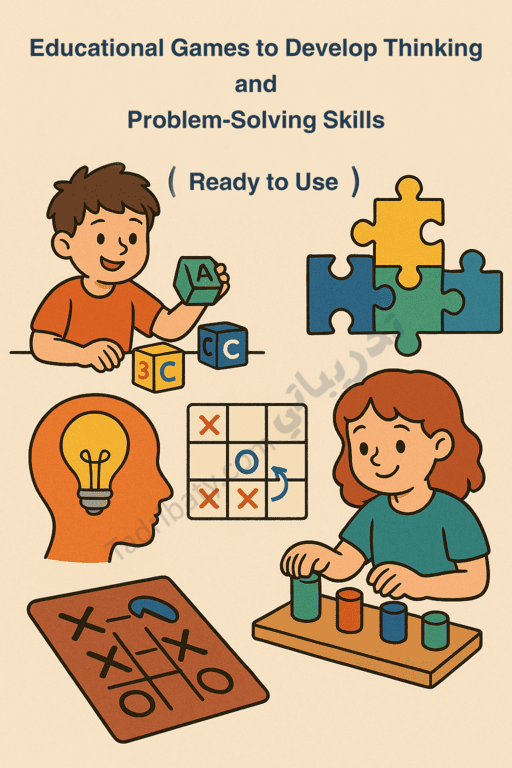
Educational games to develop thinking are among the most effective approaches for supporting active learning in classrooms and educational workshops, especially when they are ready to use and do not require complex tools or special preparation. These games are based on short, direct activities that can be implemented immediately and help learners develop thinking and analytical skills, decision-making abilities, and problem-solving skills in an interactive and enjoyable way. They also promote positive learner engagement and transform students from passive recipients into active participants in the learning process, enhancing deep understanding and creating a lasting educational impact.
📊 Table (1): Summary of Ready-to-Use Educational Games
| Game Name | Implementation Method | Targeted Skills |
| One-Minute Problem Solving | Short problem + one minute of individual thinking | Quick thinking – Decision making |
| What If? | Hypothetical question + group discussion | Critical thinking – Prediction |
| Paper Maze | Solving a maze with justification | Planning – Focus |
| Limited Construction | Few materials + specific goal | Creativity – Teamwork |
| Ranking Solutions | Ordering solution cards | Analysis – Prioritization |
| The Young Detective | Analyzing clues to reach a solution | Inference – Logical reasoning |
| Group Problem Solving | Small groups + shared solution | Communication – Collaboration |
🎯 Game (1): One-Minute Problem Solving
Objective: Develop quick thinking
Steps:
- The teacher presents a short problem.
- Students are given one minute to think individually.
- Students share their solutions orally.
- Solutions are discussed briefly.
Skills Developed:
✔ Quick thinking – ✔ Self-confidence – ✔ Rapid analysis
🎯 Game (2): What If?
Objective: Develop hypothetical thinking
Steps:
- The teacher asks a question starting with “What if…?”
- Students work in small groups.
- Solutions are presented and outcomes are discussed.
Practical Example:
What if final exams were canceled?
Skills Developed:
✔ Critical thinking – ✔ Planning – ✔ Creativity
🎯 Game (3): Paper Maze
Objective: Strengthen logical planning
Materials: Maze worksheet – Pen
Steps:
- Distribute the maze sheets.
- Students find the correct path.
- They explain the reason for choosing that path.
Skills Developed:
✔ Focus – ✔ Problem solving – ✔ Systematic thinking
🎯 Game (4): Limited Construction
Objective: Develop creativity and teamwork
Materials: Blocks – Paper – Sticks
Challenge:
Build a model that performs a specific function using a limited number of materials.
Skills Developed:
✔ Creativity – ✔ Collaboration – ✔ Planning
🎯 Game (5): Ranking Solutions
Objective: Develop prioritization skills
Steps:
- Present a problem with multiple possible solutions.
- Distribute the solutions on cards.
- Students rank them from most to least effective.
Skills Developed:
✔ Analysis – ✔ Decision making – ✔ Evaluation
🎯 Game (6): The Young Detective
Objective: Develop inquiry skills
Steps:
- Present a mysterious situation.
- Provide simple clues.
- Students analyze the clues to reach a solution.
Skills Developed:
✔ Inference – ✔ Analytical thinking – ✔ Logical connection
🎯 Game (7): Group Problem Solving
Objective: Enhance collaborative thinking
Steps:
- Present one problem to the whole class.
- Divide students into small groups.
- Discuss solutions and select the most appropriate one.
Skills Developed:
✔ Teamwork – ✔ Communication – ✔ Problem solving
📌 Table (2): When to Use These Games
| Learning Situation | Suitable Game |
| Lesson introduction | One-Minute Problem Solving |
| Activating thinking | What If? |
| Improving focus | Paper Maze |
| Teamwork activities | Limited Construction |
| Decision-making practice | Ranking Solutions |
| Analytical thinking | The Young Detective |
✨ Educational Summary
These games:
✔ Do not require special equipment
✔ Are suitable for all educational stages
✔ Can be applied in classrooms or workshops
✔ Focus on higher-order thinking skills
They are practical educational tools that help teachers transform learning into an active, enjoyable experience with real and lasting impact.
Read also:
• Ready-to-Use Educational Competitions for Schools (Ideas and Diverse Activities)
• Ready-to-Use Classroom Activities for Teachers (Immediately Applicable in the Classroom)
• Thinking Skills Every Student Needs for Academic Success
• Life Skills Every Student Should Learn (A Practical Guide for Schools and Families)