Interactive Tools in Education and Their Role in Promoting Active Learning

Interactive Tools in Education and Their Role in Promoting Active Learning
Education in the twenty-first century has undergone a profound transformation due to rapid technological advancement. Teaching and learning are no longer limited to textbooks and traditional instruction; instead, they increasingly rely on interactive educational tools and modern digital technologies that create engaging learning environments. These tools actively involve students in the learning process rather than positioning them as passive recipients of information. As a result, interactive tools have become a core pillar of active learning, contributing to the development of thinking skills, communication, and problem-solving abilities.
The Concept of Interactive Tools in Education
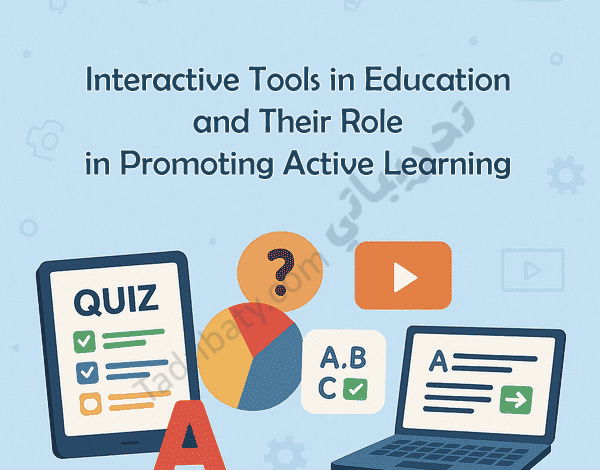
Interactive tools in education are digital applications or platforms that enable instant communication and active participation between teachers and learners, whether inside the classroom or in online learning environments. These tools include interactive presentations, educational games, learning management systems, live polling tools, as well as simulation, augmented reality, and virtual learning platforms. Their primary goal is to transform learning into a dynamic experience based on interaction, collaboration, and immediate feedback.
Examples of Interactive Educational Tools
Among the most widely used tools by teachers today are:
ClassPoint & Nearpod
Used to turn presentations into interactive learning experiences that include questions, polls, and live annotation.
Kahoot & Quizizz
Game-based learning platforms that motivate students through competition, challenges, and enjoyable learning activities.
Padlet & Jamboard
Tools for sharing ideas and conducting group discussions in a visual format that encourages collaboration and collective thinking.
Google Forms
Used to create interactive quizzes and surveys with instant analysis of results.
Canva for Education & Edpuzzle
Platforms for designing visually engaging educational content and interactive videos that allow students to engage during viewing.
The Importance of Interactive Tools in Education
Interactive educational tools help to:
-
Increase students’ motivation by making lessons more engaging and varied.
-
Enhance student participation by positioning learners as active contributors to knowledge construction.
-
Improve understanding and information retention through hands-on activities and interactive applications.
-
Provide immediate feedback that helps teachers adjust their instructional strategies.
-
Support self-directed and independent learning, especially in distance and online learning environments.
Conclusion
Integrating interactive tools into education is no longer a luxury but a necessity in order to keep pace with the demands of the digital age. These tools transform classrooms into vibrant learning environments, encourage critical and creative thinking, and provide teachers with innovative methods for assessing student performance. As technology continues to evolve, the integration of artificial intelligence and augmented reality will further enhance learning experiences, making education more interactive and effective than ever before.
Read also:
• Useful Educational Platforms and Their Role in Developing the Educational Process
• Best Virtual Classroom Applications and How to Use Them in Teaching
• How Does Artificial Intelligence Enhance Learning Inside the Classroom?
• Ready-to-Use Classroom Activities for Teachers (Immediately Applicable in the Classroom)