Using Feedback to Improve Student Learning (Examples and Ready-to-Use Models)

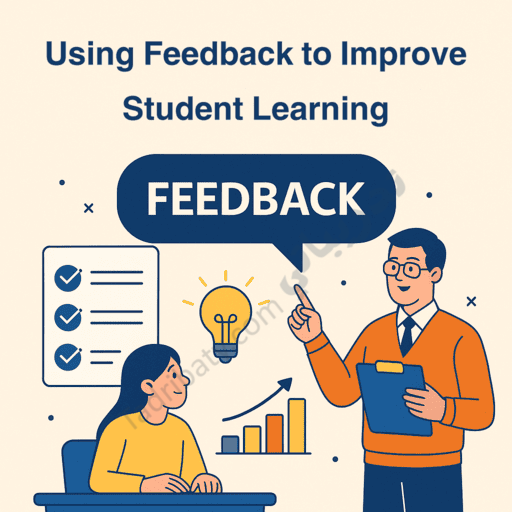
Feedback is one of the most powerful instructional tools that helps teachers improve student learning. It guides learners toward what needs improvement, highlights areas of strength, and provides a clear picture of the next steps in their learning journey. Using feedback to improve student learning is a core component of active learning, as it is directly linked to the development of thinking skills and the building of student confidence.
In this article, we explain how to use feedback effectively in the classroom, supported by practical examples and ready-to-use models that teachers can apply immediately.
First: What Is Feedback?
Feedback is information provided by the teacher to the student after completing a learning task, with the aim of:
- Correcting misconceptions
- Guiding learning
- Improving performance
- Enhancing motivation
- Supporting the student’s next steps
Feedback is not limited to correction; rather, it is a constructive dialogue that helps students understand their pathway toward mastery.
Second: Conditions for Effective Feedback
For feedback to be impactful and meaningful, it should be:
✔️ 1. Specific
Not general statements such as “Good job” or “Pay more attention,” but precise and clear:
“Your presentation was clear, but adding an example in the second paragraph would make it stronger.”
✔️ 2. Aligned with the Learning Objective
Example:
“The goal of this lesson is to distinguish between nominal and verbal sentences. You succeeded in identifying them, but you need more accuracy when identifying the predicate.”
✔️ 3. Immediate or Nearly Immediate
So students can benefit while the task is still fresh in their minds.
✔️ 4. Focused on Improvement
Feedback is not criticism; it guides students toward the next step.
✔️ 5. Encouraging and Motivating
So students do not feel discouraged or unsuccessful.
Third: Types of Feedback in the Classroom
Oral Feedback
Provided directly during the lesson.
Example:
“That’s a great idea, Ahmed. Now try to restate it using a deeper sentence.”
Written Feedback
On students’ notebooks or worksheets.
Example:
“You added important details, but the summary needs better sequencing of events.”
Whole-Class Feedback
Used when the teacher notices a common issue among many students.
Example:
“I noticed that many of you struggled with text analysis, so we will quickly revisit the analysis strategies.”
Self-Feedback
When students are trained to evaluate their own work.
Peer Feedback
When students assess each other’s work using clear criteria.
Fourth: Ready-to-Use Feedback Models
🔶 The FEED Model (Commonly Used by Coordinators)
- Feed Up: Where are we going? (Learning goal)
- Feed Back: Where are we now? (Current performance)
- Feed Forward: What is the next step? (Guidance for improvement)
Practical Example
Goal: Writing a coherent paragraph
- Feed Up: Our goal today is to write a paragraph with a main idea and supporting sentences.
- Feed Back: Your paragraph has a clear idea, but the third sentence is not well connected to the main idea.
- Feed Forward: Rewrite the third sentence so it supports your idea, then add one example to strengthen the paragraph.
🔶 The SBI Model (Situation – Behavior – Impact)
- Situation: Describe the situation
- Behavior: What the student did
- Impact: The effect of the behavior
Example
- Situation: During group problem-solving.
- Behavior: You relied on your teammates without actively participating.
- Impact: This affected your understanding of the steps and slowed the group’s progress.
- Guidance: In the next task, I want you to explain at least one step during the solution.
🔶 Positive Feedback + Correction Model
- Start with what the student did well
- Identify the improvement point
- Suggest a practical action
Example:
“Your handwriting is very clear and your organization is excellent, but you need to focus on writing hamza correctly. Try using the common-words list I gave you.”
🔶 Ready-Made Examples Across Subjects
📌 Mathematics
“You understood the concept of simplifying fractions, but you need to review the steps for finding the greatest common divisor. We will practice it tomorrow.”
📌 Science
“Your experiment is accurate and well conducted, but it needs an explanation of the result. Write one sentence explaining why the phenomenon occurred.”
📌 Arabic Language
“Your storytelling is expressive and emotional, but the middle paragraph needs better sequencing of events.”
📌 Computing
“The code works correctly, but it needs a short comment explaining the role of each step.”
Fifth: Digital Tools That Provide Instant Feedback
- ClassPoint — Live questions during instruction
- Nearpod — Interactive activities with instant analysis
- Kahoot & Quizizz — Educational games with real-time results
- Google Classroom — Individual comments on assignments
- Edpuzzle — Embedded video questions with immediate feedback
These tools support teachers and significantly reduce the time spent on grading.
Conclusion
Using feedback is not a simple classroom add-on; it is a fundamental element of successful learning. The clearer, more constructive, and more supportive the feedback, the greater the student’s chances of improvement and deeper understanding of the content.
Teachers can transform feedback from a correction process into a comprehensive development strategy that enhances academic achievement and strengthens students’ thinking skills and self-confidence.
Read also:
• Analyzing Teacher Performance in the Classroom (Clear Indicators and Evaluation Models)
• How Is a Teacher Performance Improvement Plan Built? (From Diagnosis to Follow-Up)
• Differentiated Instruction – Practical Steps and Classroom Examples
• Addressing Individual Differences in the Classroom – Practical Strategies for Teachers