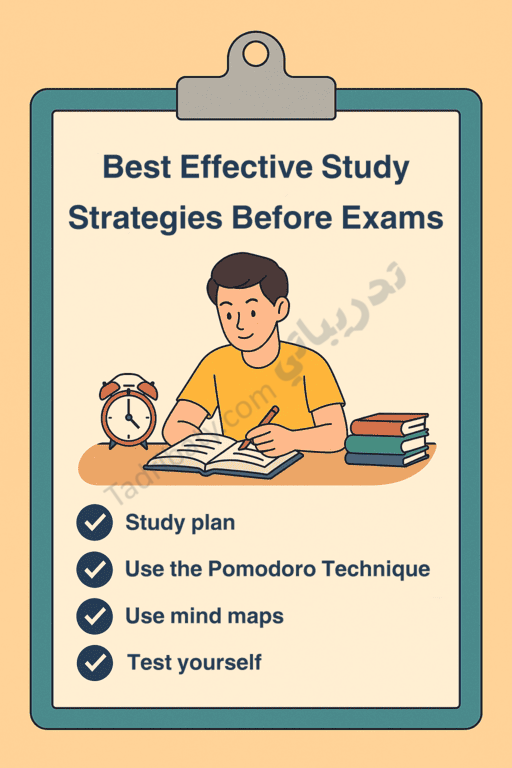
The Best Effective Study Strategies Before Exams are the real key to preparing for exams without stress or excessive pressure. As exams approach, many students feel anxious, and the need for study methods that help absorb information quickly and deeply becomes more important than ever. The issue is not only the number of study hours, but the way those hours are used. That’s why this article presents proven strategies that any student can easily apply to achieve better results.
Plan Your Study Before You Start
Planning saves you half the effort.
✔ How to plan effectively:
- Identify the subjects you need to review
- Divide your time into short study sessions
- Place difficult subjects at the beginning of your schedule
- Allocate time for final revision
Good planning helps you avoid distraction and wasted time.
Use the “Pomodoro” Study Technique
An effective method to improve focus and reduce fatigue:
- 25 minutes of focused studying
- 5 minutes of break
- After 4 sessions → take a long break (10–15 minutes)
This technique prevents burnout and increases productivity.
Start with the Basics… Then Move to the Harder Topics
When you begin studying:
- Review basic rules and formulas
- Understand the main concepts
- Connect them to examples
Strong fundamentals are the key to any subject, whether math, science, or languages.
Use Mind Maps to Simplify Understanding
Mind maps help you:
- Organize ideas
- Connect related information
- Recall content quickly
Use colors and simple drawings to turn lessons into clear visual images.
Apply More Than You Memorize
Studying is not about memorization—it’s about application.
✔ Examples of application:
- Solving previous exam questions
- Completing textbook exercises
- Using online platforms for practice
- Creating your own questions and answering them
Application is what stores information in long-term memory.
Use the “Smart Summarization” Strategy
Summarizing does not mean rewriting the textbook.
It means extracting only the most important points, such as:
- Definitions
- Formulas
- Key ideas
- Essential steps
Write them on one page for easy review.
Read Aloud to Improve Memory
Research confirms that reading aloud:
- Increases focus
- Improves comprehension
- Activates auditory memory
This method is especially effective for language and humanities students.
Test Yourself Before the Exam
The best way to check your understanding is self-testing.
Simple methods include:
- Solving past exam papers
- Using flashcards
- Asking yourself questions out loud
- Answering questions you created yourself
The more you test yourself, the stronger your memory becomes.
Study in the Right Environment
Choose a place that is:
- Quiet
- Free from distractions
- Well-lit
- Organized and tidy
A poor environment can waste half your effort without you realizing it.
Take Care of Your Health During Exam Periods
- Drink enough water
- Get good sleep (7–8 hours)
- Avoid staying up late
- Do at least 10 minutes of movement or exercise
The mind cannot perform efficiently without a rested body.
Preparing for exams doesn’t have to be exhausting. By using effective study strategies, any student can improve grades and build confidence without long hours of studying. The secret is not studying more—it’s studying smarter.
Read also:
• Simple Ways to Improve Focus and Understand Lessons Better
• How to Overcome Difficulties in a Subject and Make Progress?
• Thinking Skills Every Student Needs for Academic Success
• Educational Games to Develop Thinking and Problem-Solving Skills (Ready to Use)