How Is a Teacher Performance Improvement Plan Built? (From Diagnosis to Follow-Up)

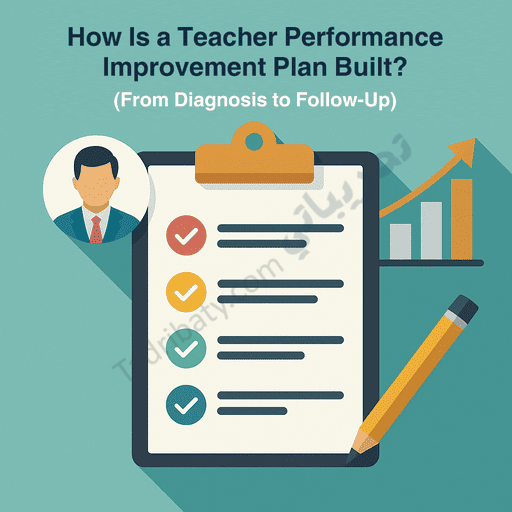
How is a teacher performance improvement plan built?
This is a fundamental question faced by educational leaders and academic coordinators, as improving teacher performance is a core responsibility that directly impacts the quality of learning in the classroom. A performance improvement plan is not a punitive document; rather, it is a professional development tool designed to support teachers and empower them to grow through clear, realistic steps.
In this article, we explain the stages of building a teacher performance improvement plan—from diagnosis to follow-up and evaluation—along with practical examples and ready-to-apply models.
First: What Is a Teacher Performance Improvement Plan?
It is a time-bound professional development plan that includes:
- One or more skills that need improvement
- Clear, measurable objectives
- Practical action steps
- Support tools and resources
- A defined timeline
- Follow-up and evaluation mechanisms
Its purpose is to enhance teaching quality and improve student learning by empowering the teacher.
Second: Diagnosis Stage (Identifying the Need)
An improvement plan begins with accurate diagnosis of teacher performance through:
✔ 1. Classroom Observations
- Lesson explanation
- Student participation
- Time management
- Quality of questioning
- Use of instructional resources
✔ 2. Analysis of Student Work
- Quality of worksheets
- Effectiveness of assessments
- Student progress over time
✔ 3. Reviewing Lesson Plans
- Clarity of objectives
- Variety of activities
- Assessment methods
✔ 4. Professional Dialogue with the Teacher
This aims to understand:
- Challenges faced
- Training needs
- Strengths and competencies
Diagnosis example:
“During multiple classroom visits, it was observed that students rarely participated in activities, and the teacher’s questions focused mainly on recall rather than understanding and analysis.”
Third: Setting SMART Goals
For an improvement plan to succeed, goals must be:
- Specific
- Measurable
- Achievable
- Realistic
- Time-bound
Examples of SMART goals:
- The teacher will use at least one thinking strategy in every lesson for four weeks.
- Student participation will reach 70% within one month.
Fourth: Designing Improvement Actions (Practical Steps)
The plan should include actionable strategies such as:
✔ 1. Attending Model Lessons
Learning from distinguished colleagues in the same subject or another grade level.
✔ 2. Short Trainings (Microtraining)
Quick workshops focused on:
- Questioning techniques
- Classroom management
- Lesson planning
✔ 3. Joint Lesson Planning
Collaboration between the teacher and the coordinator to design a model lesson.
✔ 4. Using Specific Teaching Strategies
Such as:
- KWL
- Think-Pair-Share
- Carousel
- Concept Maps
✔ 5. Applying Effective Assessment Tools
Examples include:
- Exit tickets
- Peer assessment
- Before/after comparisons
Fifth: Providing Support (Coaching)
Support is the core of the plan—not monitoring alone.
Support methods include:
- Constructive feedback after each visit
- Weekly progress review meetings
- Providing ready-to-use teaching resources
- Creating a psychologically supportive environment
- Celebrating small achievements
Sixth: Follow-Up Mechanisms
Follow-up should be continuous and objective through:
✔ 1. Regular Classroom Visits
To monitor real improvement in teaching practice.
✔ 2. Student Data Analysis
- Has understanding improved?
- Has participation increased?
✔ 3. Evaluating Implementation
- Were agreed steps followed?
- Are additional actions needed?
✔ 4. Documenting Progress
Using a simple follow-up log that includes:
- Date
- Actions completed
- Leader’s notes
- Recommendations
Seventh: Final Evaluation of the Plan
After the set period (usually 4–8 weeks):
- Compare performance before and after
- Document improvement
- Identify next steps
- Close the plan if goals are achieved
- Or extend it if improvement is insufficient
Outcome example:
“Student participation improved from 30% to 75% as a result of using interactive thinking strategies.”
Eighth: Ready-Made Examples of Improvement Plan Goals
📌 Example 1 – Improving Classroom Management
Goal: The teacher will use effective classroom signals to reduce undesirable behaviors by 50% within six weeks.
📌 Example 2 – Improving Lesson Planning
Goal: Prepare lesson plans with clear objectives and varied activities for every lesson over one month.
📌 Example 3 – Improving Use of Teaching Strategies
Goal: Integrate at least one active learning strategy in each lesson for four weeks.
📌 Example 4 – Improving Questioning Skills
Goal: Increase higher-order thinking questions (HOTS) by 25% within one month.
Conclusion
Building a teacher performance improvement plan is a gradual process that starts with diagnosis and ends with follow-up and evaluation. For the plan to succeed, it must be based on dialogue and support—not pressure or inspection. When teachers perceive the plan as a developmental tool rather than an accountability measure, it becomes a professional growth experience that enhances teaching quality and positively impacts student learning.
Read also:
• Analyzing Teacher Performance in the Classroom (Clear Indicators and Evaluation Models)
• Skills of a Successful Educational Leader – A Practical Guide to Effective School Leadership
• Applying the DISC Model to Understand Teacher Personality Types and Improve Instructional Supervision
• Using Feedback to Improve Student Learning (Examples and Ready-to-Use Models)